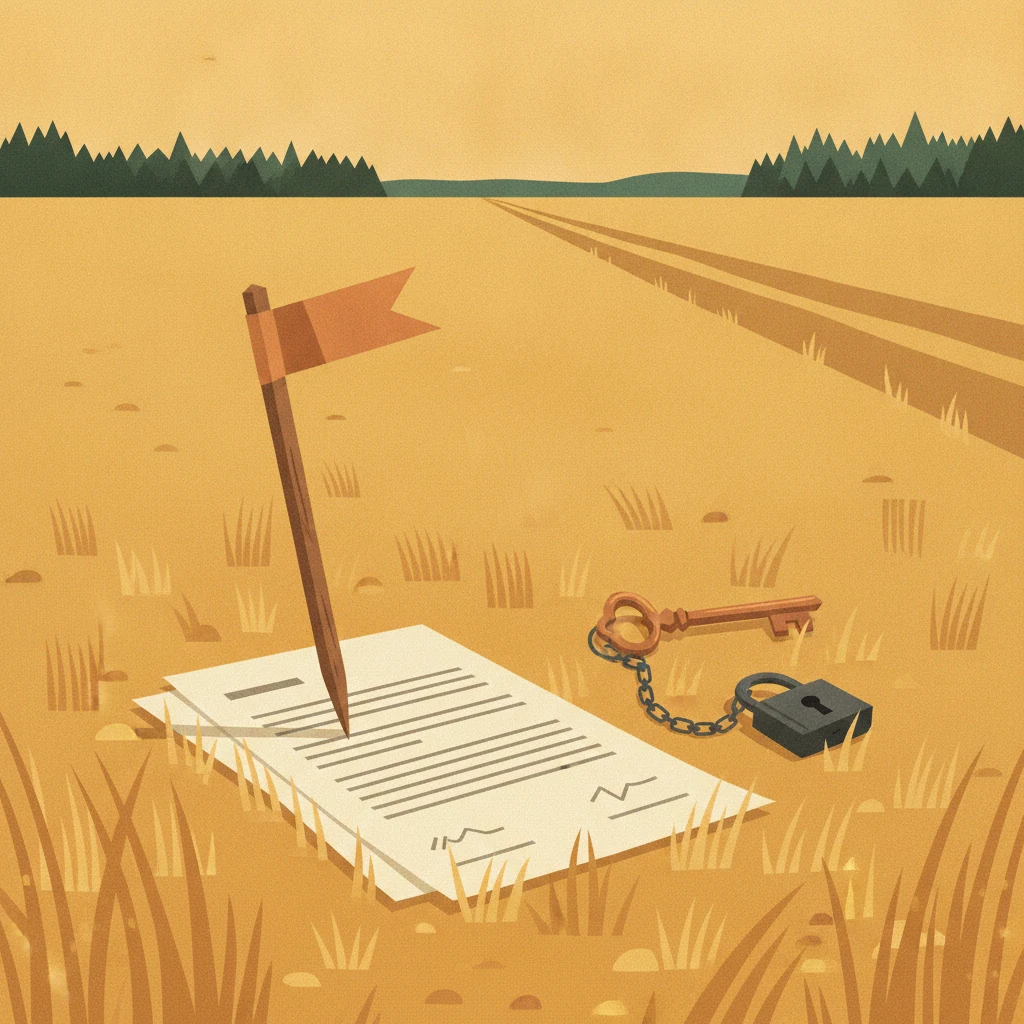
You can buy land with no money down. The catch is that almost nobody who offers it is a lender. Banks and Farm Credit associations want a large down payment on bare acreage, and the government programs people search for first either require a house or require a farming résumé. That leaves one party willing to hand over a parcel for a few hundred dollars and a signature: the seller.
Seller financing is the real answer to the no-money question, and it is not automatically a bad one. What decides whether it works out is the paper it is written on. Most zero-down land offers use a contract for deed — also called a land contract or installment contract — and under that document you are not the owner of the land you are paying for. You become the owner when the last payment clears, and not a day sooner.
This is a guide to that one decision: when a zero-down contract for deed is worth signing, what has to be in it, and when the smarter move is to walk away and save a down payment.
Why the Lenders Are Not in This Conversation
Institutional lenders treat raw land as the riskiest real estate they touch, and their down payments reflect it. Federal banking guidelines set a supervisory loan-to-value limit of 65 percent for raw land, which works out to 35 percent down before a bank even needs to explain itself to an examiner. 12 CFR Part 365, Interagency Guidelines for Real Estate Lending In practice Farm Credit and rural community banks ask for roughly 20 to 35 percent. You can see what that does to a monthly payment in our land loan calculator.
The government programs do not fill the gap for an ordinary buyer. USDA's zero-down housing loans finance a dwelling, not acreage — we covered the details in why USDA loans fail for raw land. The one federal program that will finance 100 percent of a land purchase is the Farm Service Agency's Direct Farm Ownership loan, capped at $600,000, and it is reserved for people with documented farm management experience, generally three years. USDA Farm Service Agency, Farm Ownership Loans If you are a working farmer, start there. If you are buying a place to camp, hunt, or build on someday, you are not eligible.
What You Actually Sign in a Zero-Down Deal
Seller financing comes in two forms, and the difference between them matters more than the interest rate. In the first, the seller gives you a deed at closing and takes back a promissory note secured by a mortgage or deed of trust. You own the land. If you default, the seller has to foreclose, with the notice periods and sale procedures your state requires.
In the second, the contract for deed, the seller keeps legal title for the entire term. You get possession and the obligation to pay the taxes, and you get a deed only after the final installment. If you miss payments, many states let the seller cancel the contract and keep everything you have paid, without ever going to court. That remedy is called forfeiture, and it is the reason sellers of cheap rural lots prefer this document. It is also why they can afford to skip the down payment and the credit check: taking the land back is fast and cheap.
A down payment is the lender's protection. In a zero-down contract for deed, the seller's protection is that you do not own anything yet.
The Protections You Have Heard About Mostly Cover Houses
State legislatures have spent years reining in contracts for deed, and most of that work stops at the edge of a vacant lot. The reforms were written for families buying homes, so the statutes are typically limited to residential property. A buyer of bare land for recreation or investment often falls outside them and is left with whatever the contract says.
| State | What the statute does | Does it reach vacant land? |
|---|---|---|
| Texas | 30-day notice and cure; seller must record the contract; after 40% paid or 48 monthly payments the seller must use a foreclosure-style sale | Only property used or to be used as the buyer's residence |
| Ohio | Foreclosure required once the buyer has paid for 5 years or paid 20% of the price | No. Applies to property improved by a dwelling |
| Minnesota | Seller may cancel without a lawsuit by serving notice; buyer generally has 60 days to cure | Yes, but cancellation is still out of court |
| Oklahoma | Contracts for deed are treated as mortgages; seller must foreclose | Yes |
The table shows how much your position depends on the state line. In Oklahoma the label on the document barely matters because the law treats it as a mortgage. In Texas and Ohio the well-known protections may not apply to you at all if there is no home on the parcel and you do not intend to live there. Texas Property Code Ch. 5, Subchapter D Ohio Revised Code Ch. 5313 Minnesota Statutes § 559.21 Oklahoma Statutes Title 16, § 11A Before you sign in any state, find out which rule governs a default on unimproved land there. A one-hour consult with a local real estate attorney costs less than two monthly payments.
Federal law has the same blind spot. The mortgage rules most people associate with consumer protection, such as the ability-to-repay requirement, apply to credit secured by a dwelling. A vacant lot has no dwelling. The main federal statute that does reach land is the Interstate Land Sales Full Disclosure Act, which applies to developers selling 100 or more lots under a common plan. Those sellers must give you a Property Report before you sign, and you can cancel within seven days of signing, or within two years if you never received the report. CFPB Regulation J (12 CFR Part 1010) If you are buying from a large subdivision operation and no Property Report has appeared, ask for it by name.
Five Terms That Make a Contract for Deed Survivable
A contract for deed is negotiable, and a seller who refuses every item below is telling you how the deal is meant to end. None of these costs the seller anything if they intend to deliver the land.
- A title search before you sign, not at payoff. You are about to spend years paying for land the seller may not own cleanly. Existing mortgages, tax liens, and judgments against the seller sit ahead of you. Pay a title company for a search and read it.
- A recorded memorandum of contract. An unrecorded contract is invisible to the world. If the seller borrows against the parcel, gets sued, or sells it to someone else, a recorded memorandum in the county land records is what puts everyone on notice that you have an interest.
- The deed signed now and held in escrow. Have the seller sign a warranty deed at the start and deposit it with a title company or attorney, with instructions to release it at payoff. Sellers die, divorce, dissolve their LLCs, and stop answering the phone. You do not want to chase a signature in year nine.
- A written cure period and a default definition. Ask for at least 30 days' written notice and a right to catch up before any cancellation, and make sure one late payment is not defined as a default of the whole contract.
- No balloon, and no prepayment penalty. A balloon payment in year three or five turns a zero-down deal into a deadline to find the bank loan you could not get in the first place. You want a fully amortizing schedule you can pay off early.
Better than all five: ask the seller to use a deed and a deed of trust instead. Some will, particularly individual owners as opposed to volume lot dealers, and often in exchange for a modest down payment. That one change gives you title on day one and foreclosure protections if things go wrong.
When Zero Down Is Fine, and When to Walk
A zero-down contract for deed is a reasonable tool when the amount at risk is small and the term is short. If the parcel is a few thousand dollars, the payoff is two or three years away, the title is clean, and the memorandum is recorded, the worst case is losing a limited sum on land you got to use. Plenty of people buy their first acre this way and get their deed.
The same structure becomes dangerous as the numbers grow. Walk away when the term runs ten years or more with forfeiture as the remedy, when the seller will not allow a title search or recording, when the price is far above comparable cash sales, or when you plan to put a well, septic, or cabin on the land before you hold title. Improvements you build on a contract-for-deed parcel belong to the seller if the contract is cancelled. Run the carrying costs first as well: taxes, access, and insurance are yours from day one, and our breakdown of what you pay just to own raw land and the holding cost calculator will show you whether the payment is really the whole payment.
Zero down also does not excuse you from due diligence. A seller-financed lot with no legal access or no chance of passing a perc test is a bad purchase at any down payment, and the installment price usually has the seller's risk baked into it. Work through the raw land due diligence checklist before you sign, exactly as you would if you were paying cash.
The Honest Alternative
If the deal in front of you fails the tests above, the better no-money strategy is a slower one. Six to twelve months of saving toward 20 percent down on a modest parcel gets you a real loan, a deed at closing, and a seller who has to compete on price instead of on easy terms. Ask the seller of the lot you like whether they would take 10 or 15 percent down with a deed of trust. The answer is yes more often than the listing suggests, and it is the single question that separates a seller who wants to sell land from one who expects to get it back.
Sources
- 12 CFR Part 365, Appendix A — Interagency Guidelines for Real Estate Lending Policies
- USDA Farm Service Agency — Farm Ownership Loans
- Texas Property Code Chapter 5, Subchapter D — Executory Contract for Conveyance
- Ohio Revised Code Chapter 5313 — Land Installment Contracts
- Minnesota Statutes § 559.21 — Termination of Contract for Deed
- Oklahoma Statutes Title 16, § 11A — Contracts for Deed as Mortgages
- CFPB Regulation J, 12 CFR Part 1010 — Interstate Land Sales Registration
This article is general information, not legal advice. Contract-for-deed law varies by state and changes; confirm the current rule with a licensed attorney where the land is located.