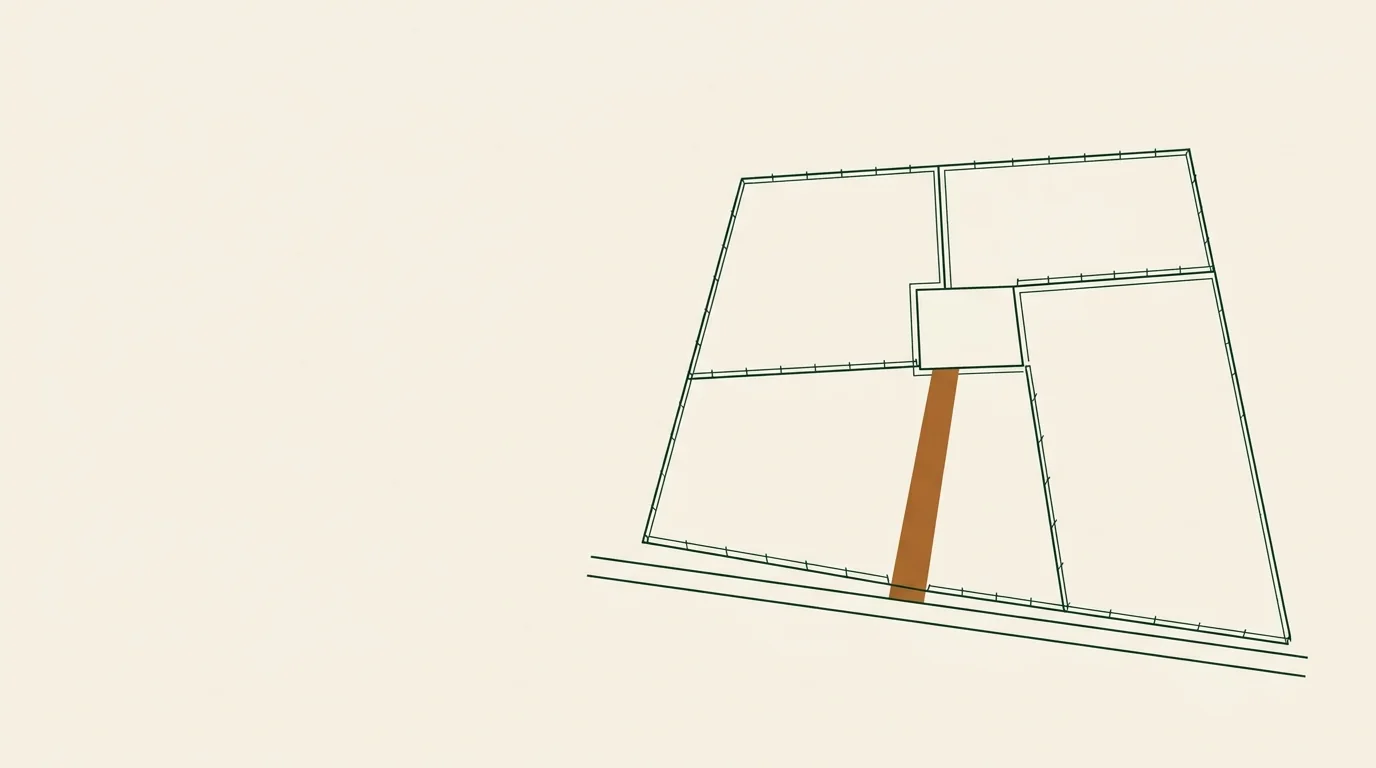
The short version
A parcel is landlocked when it has no legal way to reach a public road. A dirt track across a neighbour’s land is not the same as a legal right to use it. Without legal access you may not be able to get a building permit or a loan, a title insurer may exclude access from your policy, and the land is worth much less. Sometimes access can be fixed by agreement, a court-recognised easement or, in some states, a statute that lets you buy a right of way; all of those take time and money. Check before you buy.
Kinds of access, strongest first
- Road frontage: the parcel touches a public road.
- Recorded easement: a written, recorded right to cross someone else’s land, ideally one that “runs with the land” to future owners and is wide enough for a driveway and utilities.
- Easement by necessity or implied easement: courts in many states recognise access when a larger parcel was split and one piece was left without a road. You usually have to prove it, sometimes in court.
- Prescriptive easement: a right gained by long, open use without permission, for a period set by state law. Hard to prove, and you usually need a court ruling.
- Informal permission: a neighbour lets you cross. It can be withdrawn at any time, and it ends when the land is sold.
If the land has no legal access
- Negotiate an easement with a neighbour and record it. Expect to pay for it.
- Use a state way-of-necessity statute where one exists: some states let a landlocked owner ask a court or county to establish a private way across a neighbour’s land, paying the neighbour compensation. Examples: Washington (a private condemnation action in court, where you may also have to pay the neighbour’s legal and expert costs), Oregon (a petition to the county governing body, available only when no other legal route to access exists), Wyoming (since 2013, an action in district court) and Florida (a statutory way of necessity for land used or to be used for a home, farming, timber or livestock that has no practicable route to a road; compensation is set in circuit court).
- Ask a court to recognise an easement by necessity, if the history of the parcels supports it.
- Buy an adjoining strip that reaches the road.
Protect yourself before you buy
- Get a title search and survey that show how the parcel reaches a public road.
- Check what the title policy covers: a standard owner’s policy insures against having no legal right of access; an access endorsement (ALTA 17, where offered in your state) goes further and insures actual vehicle and foot access to a named street the land touches. If access runs over an easement, ask about the indirect-access version (ALTA 17.1). Read Schedule B: if the insurer lists an exception for access, you don’t have that coverage.
- Make the purchase contingent on confirmed legal access wide enough for the use you plan, including utilities.
- If access depends on an easement, read it: who maintains the road, whether it allows a house, and whether it includes utilities.
This is item 1 on our raw land due diligence checklist.
Quick answers
What is landlocked property?
Land with no legal access to a public road, either by frontage or by a recorded easement across a neighbour’s land.
Can you get access to landlocked property?
Often, but it takes effort: negotiate and record an easement, use a state way-of-necessity statute where available, ask a court to recognise an easement by necessity, or buy a strip of land to the road.
Is it a bad idea to buy landlocked land?
It is risky unless the price reflects the access problem and you have a realistic, affordable way to secure legal access. Without it you may not get a permit or a loan, and a title insurer may exclude access from coverage.
Can a neighbour block access to my land?
If you only have informal permission, yes. A recorded easement or an access right established by a court or statute can’t simply be withdrawn, though an easement by necessity can end if the necessity ends (for example, when a new road reaches the land).
General information, not legal, tax or financial advice. Land rules differ by state and county; confirm with the county health or planning department, a real estate attorney or a licensed professional before you buy.
Sources
- Cornell LII — Easement; prescriptive easement — www.law.cornell.edu/wex/easement
- Washington RCW 8.24.010 — private ways of necessity — app.leg.wa.gov/rcw/default.aspx?cite=8.24.010
- Oregon ORS 376.150 — ways of necessity — oregon.public.law/statutes/ors_376.150
- Wyoming 2013 HB 134 — private road actions moved to district court — www.wyoleg.gov/2013/Digest/HB0134.htm
- Florida Statutes 704.01 — statutory way of necessity — www.flsenate.gov/Laws/Statutes/2025/704.01
- ALTA owner’s policy (2021) — covered risk: no right of access — floir.gov/docs-sf/property-casualty-libraries/title-insurance-2021-forms/2021-alta-owners-policy.pdf
- ALTA 17 access and entry endorsement (sample form) — uploads.prod01.oregon.platform-os.com/instances/2061/assets/forms-library/ALTA_17.pdf